
Marion County Court Records After Arrest
After a Marion County arrest, the first record is usually a jail booking or commitment record. That record is tied to Marion County Jail, the arresting agency, the warrant, citation, or other legal process, and the first custody decision. The court record is different. It begins when the case is filed, when a lower-court matter is bound over, or when the prosecutor files an accusation, information, or indictment. The Chattahoochee Judicial Circuit District Attorney handles felony prosecution for Marion County, and the District Attorney's Office is the prosecution office for the circuit that includes Marion County.
That split matters because court records after a jail arrest are not just arrest records. A jail booking can show what the person was arrested for, but formal court records show what charge was filed, what bond orders were entered, whether the charge was amended, and how the case moved toward disposition. For live custody and booking details, use the Marion County jail inmate records route. For booking photos, use the Marion County jail mugshots route. The court record is the filing and case-history side of the same event.
The Marion County Clerk of Superior and Juvenile Court is a key local record office. The clerk page says the office keeps Superior Court records for the Chattahoochee Judicial Circuit and handles criminal court filings and processing. It identifies Clerk Joy Smith and gives the clerk phone as (229) 649-7321 and email as joy.smith@gsccca.org. The clerk can help locate case records and copies when a filing exists, but the clerk page also states that clerks and deputy clerks cannot give legal advice.
The Marion County clerk page shows the local clerk's criminal filing and court-record duties. That source is a strong match for Marion County court records after a jail arrest because it gives the office that maintains filed criminal case material after the booking stage ends.
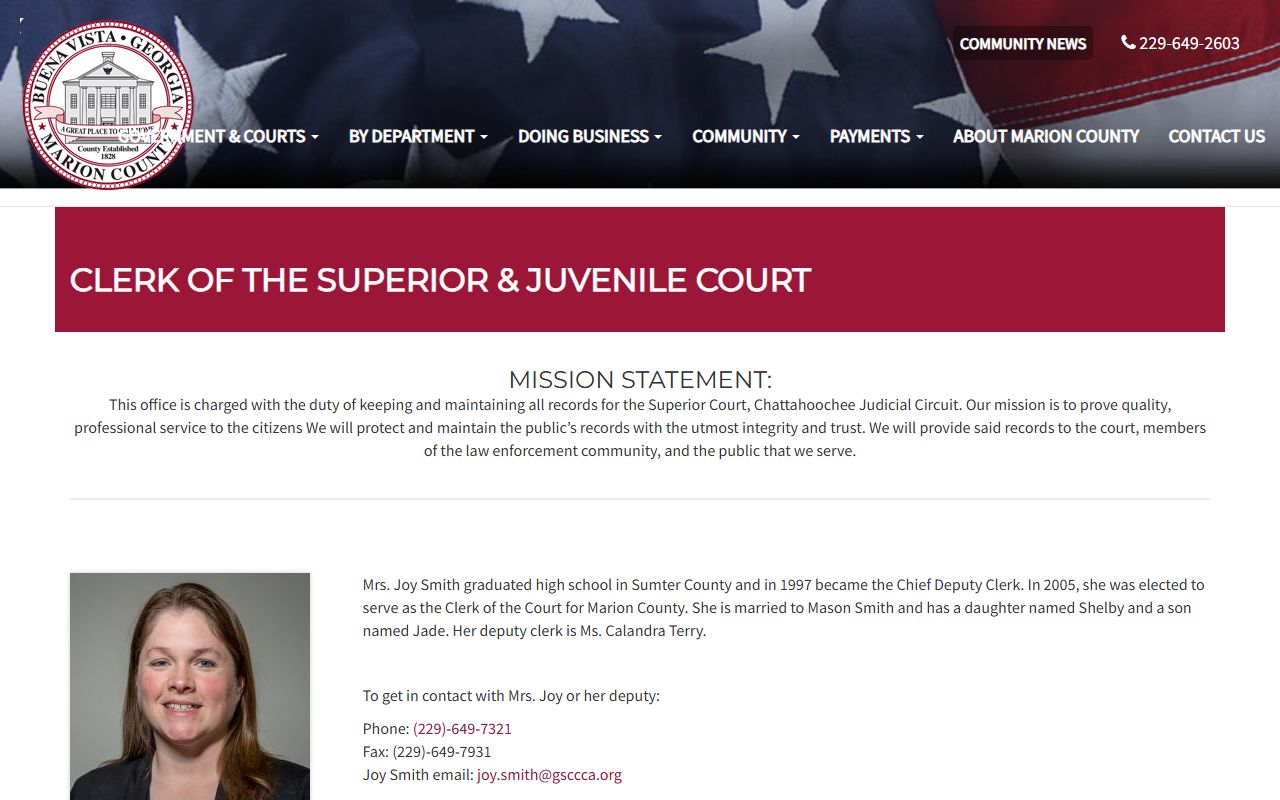
The clerk screenshot supports the local routing used here: jail staff answer custody questions, while the clerk and court-access provider handle filed court records.
Find Marion County Court Records After Arrest
Georgia Courts lists Marion Superior Court on its e-access page as a court connected to PeachCourt. The same Georgia Courts page states that users are redirected to the provider website and must have an account to search court records through participating providers. That means a Marion County court records search after an arrest may require a PeachCourt account for online access, especially for Superior Court criminal filings. If the case is too new, too old, sealed, or not available through the provider account, the practical next step is the clerk's office.
- Confirm the arrest and booking event through the jail if current custody is still in question.
- Ask for a court case number, citation number, warrant number, bond-order reference, or court name if staff can release it.
- Use Georgia Courts e-access to confirm that Marion Superior is linked through PeachCourt.
- Search PeachCourt from a provider account by defendant name, case number, and available date filters.
- Contact the Marion County Clerk of Superior and Juvenile Court when the case is not online or when a copy is needed.
The online court search should be treated as a case-record channel, not as a jail roster. It can help find filed charges, hearing activity, bond orders, and outcomes. It does not replace a jail phone call for current custody, and it does not mean every arrest will have a visible online filing within the first hours after booking. For statewide criminal-history records, use the Georgia Bureau of Investigation criminal-history channels, not the county jail and not PeachCourt alone.
| Field | Type | Required | Use for Marion County |
|---|---|---|---|
| PeachCourt account | Login | Required for provider search | Georgia Courts says provider users must have an account. |
| Court selection | Provider selection | Required | Select Marion Superior when searching Superior Court records. |
| Defendant name | Text | Provider-dependent | Use the full legal name from the booking or bond paperwork. |
| Case number | Text | No, if unknown | Use any number from a citation, warrant, clerk notice, or bond order. |
| Date range | Date filter | Provider-dependent | Useful when searching soon after a Marion County arrest. |
| Case type | Filter | Provider-dependent | Criminal filters vary by provider account and court setup. |
The Georgia Courts e-access page is the source that ties Marion Superior Court to a provider search route. It is the right source for the online-court-access part of a Marion County court records after arrest workflow.
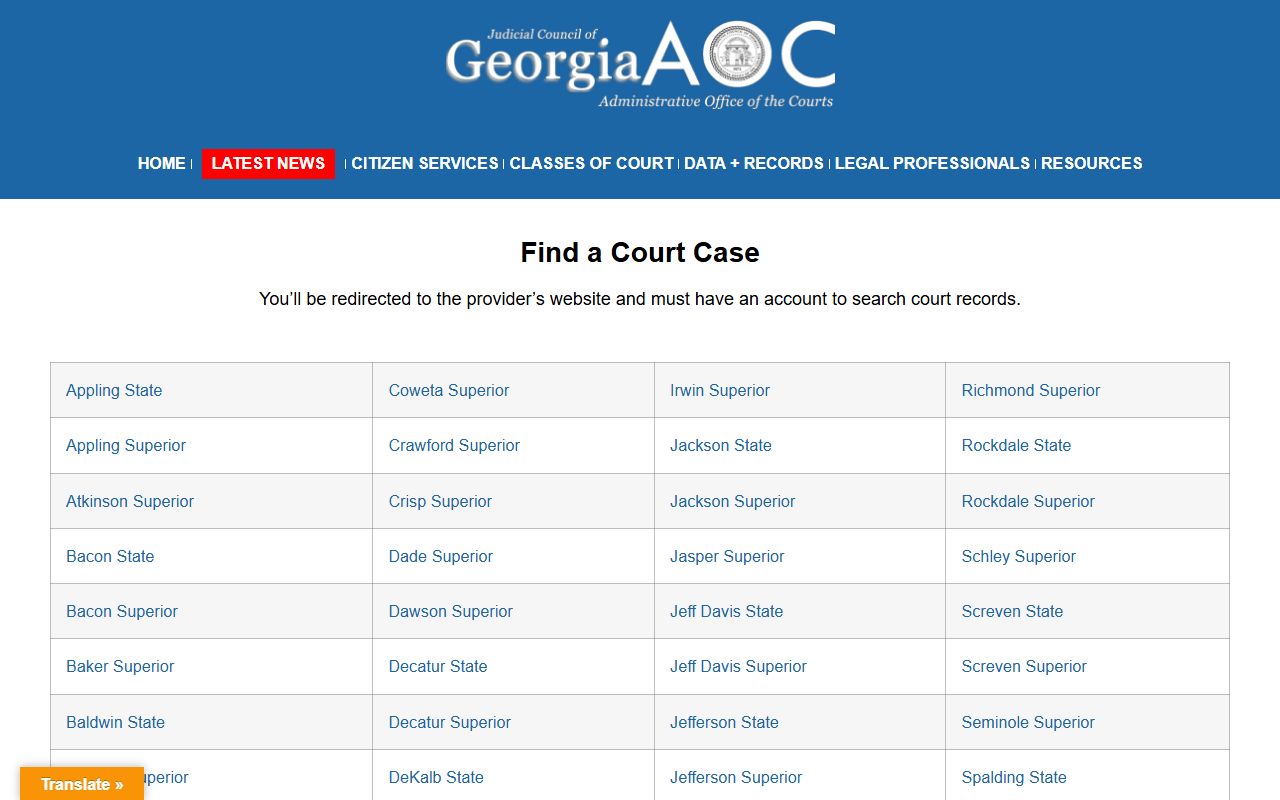
The e-access listing explains why a reader may need both PeachCourt and the Marion clerk instead of expecting a county jail roster to show filed court charges.
Marion County Arrest Charges Filed in Court
A Marion County jail charge is the arresting or booking charge. It may come from an officer's arrest report, a warrant, a citation, or a court order. A formal court charge is the filed allegation that moves through the court docket. The prosecutor can change the charge after review, decline a charge, add a count, reduce a count, or file a felony case through the Chattahoochee Judicial Circuit District Attorney. That is why court records after a jail arrest should be checked even when the jail has already confirmed a booking.
| Document | Who Usually Files It | Common Use | What to Check |
|---|---|---|---|
| Complaint | Officer or prosecutor | Early criminal allegation or lower-court matter | Charge description, sworn facts, warrant or citation link. |
| Information or accusation | Prosecutor | Prosecutor-filed criminal charge | Count number, statute, offense level, and filing date. |
| Indictment | Grand jury | Felony charge presented by grand jury | Counts, defendants, grand-jury action, and later amendments. |
The exact document depends on court level, charge type, and prosecutor action. Marion County Superior criminal matters are part of the Chattahoochee Judicial Circuit, while city ticket or failure-to-appear matters may involve Buena Vista municipal channels. The Buena Vista Police Department page says unpaid or missed city ticket cases can lead to an arrest warrant and driver's-license suspension, so a city citation may produce both a warrant event and later court activity.
Marion County Court Charge Status
Charge status terms are often the most useful part of a court record after an arrest. They show whether the filed charge is still active, changed, ended, or resolved. They also help separate an allegation from a conviction. Marion County jail records can show the crime charged at commitment under Georgia jail-record law, but court records show later case movement, including amended charges, bond motions, hearings, pleas, dismissals, no bills, and convictions.
| Status | Meaning in a Court Record | Why It Matters After Arrest |
|---|---|---|
| Pending | The case or charge has not reached final disposition. | The arrest has led to an open matter that should be tracked through the court. |
| Amended | The charge was changed after the first filing. | The filed court charge may no longer match the booking charge. |
| Reduced | The charge was lowered to a lesser offense. | The final record may be less severe than the jail intake label. |
| Dismissed | The charge was ended by court or prosecutor action. | A dismissed charge is not the same as a conviction. |
| Nolle prosequi | The prosecutor chose not to proceed on the charge, subject to court process. | This may affect public record restriction and commercial booking-photo removal issues. |
| Conviction | A guilty plea, verdict, or other conviction disposition was entered. | Conviction status changes how the record appears in court and criminal-history contexts. |
For felony prosecution status, the Chattahoochee Judicial Circuit District Attorney is the relevant prosecutor source. The DA is not the custodian of jail booking records or mugshots. The DA is useful for understanding prosecution routing, victim-witness services, and the role of prosecutor-filed charges after a Marion County arrest.
Bond After Marion County Arrest
No Marion County Jail bond page was located in official sources, so bond questions should start with the jail and then move to the court record. Georgia law supplies a judicial-officer timing anchor for taking arrested persons before a judicial officer within the statutory 48-hour framework in covered circumstances, but weekends, warrants, court availability, medical issues, and holds can affect a specific booking. Once a bond order exists, the court record may show the bond type, later bond changes, failure-to-appear action, or revocation.
| Bond or Hold | How It Works | Marion County Checkpoint |
|---|---|---|
| Cash bond | The full amount is paid to the proper jail or court authority. | Call the jail before assuming where payment is accepted. |
| Surety bond | A licensed Georgia bonding company posts bond for a fee. | Confirm the charge, fee, and release terms in writing. |
| Property bond | Qualifying property is used as security if accepted by the court. | Ask which court must approve the property bond. |
| Personal recognizance | Release is based on promise and conditions rather than full payment. | Read the court order for reporting and hearing terms. |
| No-bond hold | The person cannot be released until a judge or issuing court acts. | Ask whether the hold comes from the local case or another agency. |
| Detainer | Another county, state, federal, probation, parole, or immigration agency may prevent release. | One local bond may not clear all custody barriers. |
A bond record can sit in more than one place. The jail may see the immediate custody status. The court may hold the written bond order. The clerk may have the docket entry after filing. The issuing court or outside agency may control a warrant hold. That is why a Marion County court records search after arrest should include both the custody channel and the court channel when release status is unclear.
Warrants Before Marion County Arrest
No official Marion County sheriff active-warrant search page was located. The county sheriff page says the sheriff's office serves criminal warrants, subpoenas, and civil processes, and it also lists courthouse security and inmate transport duties. For a person already arrested, the jail record should identify the process under which the person was committed and the court that issued the process, because Georgia law requires the sheriff's jail record to keep those baseline fields.
Bench warrants and failure-to-appear warrants are common links between court records and new jail bookings. The Buena Vista Police Department page adds a city-ticket example: if a ticket is not paid before court or the person does not appear, an arrest warrant may issue and the driver's license may be suspended. That does not create a countywide web warrant database, but it does show why a city citation can become a Marion County booking and then a court-record search.
- Arrest warrant
- A court-issued order authorizing arrest for an alleged offense.
- Bench warrant
- A judge-issued warrant, often tied to failure to appear or violation of a court order.
- Detainer
- A hold or request from another agency that may block release even after local bond is addressed.
- Disposition
- The current or final outcome of a charge in court records.
Note: Public GCIC or NCIC warrant searching is not available as a direct Marion County public lookup channel.
Charges vs Convictions in Marion County
A charge is an accusation. A conviction is a finding or plea of guilt. The difference is central to Marion County court records after a jail arrest because a person can be booked, charged, and later have the case dismissed, reduced, no billed, nolle prossed, or resolved without a conviction on every count. A court record should be read by count and by date, not as one fixed label copied from the jail intake stage.
| Point | Charge | Conviction |
|---|---|---|
| Stage | Allegation filed or listed after arrest. | Final or current guilty outcome by plea, verdict, or qualifying disposition. |
| Proof | Based on arrest, warrant, complaint, accusation, information, or indictment. | Requires court resolution under criminal-procedure rules. |
| Record Use | May explain why a person was booked or why a case opened. | May affect sentence, probation, GDC status, and criminal-history reporting. |
| What to Verify | Charge text, statute, count number, and status. | Disposition date, sentence, appeal status, and any restriction order. |
Restricted Marion County Arrest Records
Georgia often uses the term record restriction for limiting public dissemination of eligible criminal-history information. The Georgia Bureau of Investigation has statewide resources for criminal-history record restrictions, while the court and clerk records show the case result that may matter for eligibility. A person asking about dismissal, acquittal, nolle prosequi, no bill, or other case outcomes should rely on court records and legal counsel rather than asking jail staff to decide eligibility.
| Issue | Restricted or Sealed Access | Expungement or Removal Claim |
|---|---|---|
| Meaning | Public access to eligible information may be limited under Georgia procedure. | Often used casually, but Georgia official sources commonly discuss record restriction. |
| Where to Check | GBI restriction guidance, court orders, clerk records, and case disposition. | Court and criminal-history channels, not the jail roster alone. |
| Booking Photo Link | Case outcome may affect commercial booking-photo removal rights. | Commercial publisher removal is separate from changing an official court or jail record. |
| Legal Advice | Clerks can provide records but cannot advise on eligibility. | Eligibility questions belong with an attorney or the proper legal process. |
Georgia's commercial booking-photo removal statute is one reason court outcomes matter. A dismissal, nolle prosequi, no prosecution, no bill, acquittal, or restricted case access may support a commercial-site removal demand under state law, but that is not the same as deleting the county's original jail record or the court's docket history.
Marion County Background Check Limits
Casual court-record lookup and regulated background screening are different. PeachCourt, the clerk, the jail, GBI, and prosecutor records can all answer different public-record questions, but employment, tenant, credit, insurance, and other consumer-screening uses are governed by stricter law. A filed charge after a Marion County arrest should not be treated as a conviction unless the court record shows a conviction disposition.
Important: Public lookup information must not be used for FCRA-covered decisions such as employment, housing, credit, or insurance screening.
Offline Marion County Court Records
Not every Marion County court record after an arrest will be easy to find through an online provider account. A matter may be too new for online indexing, too old for provider display, outside Superior Court, restricted, juvenile, sealed by court order, or tied to an ongoing investigation. When a PeachCourt search does not show the expected case, the next step is a specific request to the Marion County Clerk with the defendant name, arrest date, case number if known, and the type of record needed.
The PeachCourt provider page is relevant because Georgia Courts points Marion Superior e-access users to a provider route. Provider access is useful, but it does not remove the need for clerk contact when the online search is incomplete.

For prosecution context, the Chattahoochee Judicial Circuit Superior Court page confirms that Marion County is part of the circuit and that criminal sessions are held in each county courthouse.